The most important thing to know when using an ORM for your database querying is what exactly happens behind the scene. Do you know if what you are doing will produce acceptable SQL? Do you know if the query will execute fast? Worst of all, do you know how many queries will be executed?
To help answer those questions we need to profile our ORM. Good tools like SQL Profiler, Entity Framework Profiler and NHibernate Profiler exists but you need to spend money for them.
On the free side of things, MiniProfiler is a library we can add to our project via a NuGet package for Entity Framework in this case. MiniProfiler was created for ASP.Net MVC applications in mind but we can still use it in a desktop application using another library called MiniProfiler.Window.
Here is a small example on how to use both libraries together:
This will output to the console the duration of the execution, the raw SQL and parameters of the query. Of course we'll want to refactor this code a bit but it gives you an idea on how MiniProfiler works.
Just a small warning, for reasons unknown to me mixing MiniProfiler and Entity Framework's database initialization like DropCreateDatabaseAlways is not working. As long as we are disabling the initialization with Database.SetInitializer<Context>(null) everything's working just fine.
Sunday, February 3, 2013

Thursday, November 1, 2012
Querying TFS using Roslyn
Roslyn is an ambitious new project by Microsoft. It is the fully written in .Net replacement of the old compilers used in Visual Studio and should be shipped in a future version of the IDE. The current compilers csc.exe and vbc.exe were first shipped in version 1.0 of .Net more than 10 years ago.
Roslyn offers a lot of new possibilities. As of today Roslyn in still is in CTP and the latest release was in September 2012. For this first post on Roslyn I want to explore the new C# Interactive window (you will need to download and install the CTP for that).
For this demonstration I'll use one of my previous query for LinqPad, Searching in all work items.
First we need to open the C# Interactive window (from menu VIEW -> Other Windows -> C# Interactive)
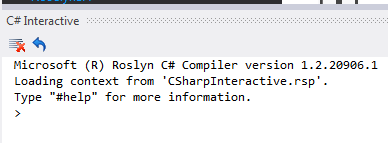
Then we start by referencing the required libraries using the special #r instruction
Next we need to import the namespaces we are going to use with the using statement like this
Now we are ready to write some real code. I'll be using my online Team Foundation Service account for this. You can register for a free account here.
Of course we don't have access to LinqPad's Dump function so we have to print the results ourself.
I think using LinqPad is still easier for this kind of work but those who don't have a paid version of LinqPad will like the facts that Roslyn is free, offers a way to write queries using Intellisense and also a more interactive way to work and find the data you are looking for.
Roslyn offers a lot of new possibilities. As of today Roslyn in still is in CTP and the latest release was in September 2012. For this first post on Roslyn I want to explore the new C# Interactive window (you will need to download and install the CTP for that).
For this demonstration I'll use one of my previous query for LinqPad, Searching in all work items.
First we need to open the C# Interactive window (from menu VIEW -> Other Windows -> C# Interactive)
Then we start by referencing the required libraries using the special #r instruction
> #r "Microsoft.TeamFoundation.Client"
> #r "Microsoft.TeamFoundation.Common"
> #r "Microsoft.TeamFoundation.VersionControl.Client"
> #r "Microsoft.TeamFoundation.WorkItemTracking.Client"
Next we need to import the namespaces we are going to use with the using statement like this
using Microsoft.TeamFoundation.Client;
using Microsoft.TeamFoundation.WorkItemTracking.Client;
Now we are ready to write some real code. I'll be using my online Team Foundation Service account for this. You can register for a free account here.
> var uri = new Uri("https://my.visualstudio.com/DefaultCollection/");

> var tfs = TfsTeamProjectCollectionFactory
    .GetTeamProjectCollection(uri);

> tfs.EnsureAuthenticated();

> var workItemStore = tfs.GetService<WorkItemStore>();

> var title = "phone";

> var query = string.Format(@"
    Select [Id], [Work Item Type], [Title], [State]
    Where [Title] Contains '{0}'
    From WorkItems",
    title);

> var results = workItemStore.Query(query).Cast<WorkItem>()
    .Select(wi => new
    {
        wi.Id,
        wi.AreaPath,
        Type = wi.Type.Name,
        wi.Title,
        wi.State
    })
    .OrderBy(wi => wi.AreaPath).ThenBy(wi => wi.Type).ThenBy(wi => wi.Title);
Of course we don't have access to LinqPad's Dump function so we have to print the results ourself.
> foreach (var r in results)
{
    Console.WriteLine("{0} - {1} [{2}] {3} <{4}>",
        r.Id, r.AreaPath, r.Type, r.Title, r.State);
}
2 - Project1 [Bug] Bug #1 - Fix the phone number on the Contact page <New>
I think using LinqPad is still easier for this kind of work but those who don't have a paid version of LinqPad will like the facts that Roslyn is free, offers a way to write queries using Intellisense and also a more interactive way to work and find the data you are looking for.
Sunday, October 7, 2012
How to reference and reuse LinqPad queries
One missing feature from LinqPad is the ability to easily reuse code in a query we wrote in other queries.
If we really want to do it we have the following options:
Today we will look at the third option. Found in the .Net framework is a very interesting API called the CodeDOM API. This API can be used to compile .Net code at run-time, like the compiler does. With this, we will be able to parse a LinqPad query and compile it.
This is what we will look into right now.
Those are the steps we need to do to accomplish query compilation:
I'll explain in details each steps in future blog posts but for now I'll give you my query to compile LinqPad queries. You will notice that this is a self compiling query as the query compile itself to a dll I can reuse it to compile other queries!

You can figure out the Compiler class usage from the Main function for now.
System.Runtime.InteropServices
Microsoft.CSharp
If we really want to do it we have the following options:
- Copy and paste the code into the new query
- Open Visual Studio, create a project, create a class and copy the code you want to reuse. Compile the project and finally reference the generated dll from your query.
- Compile the LinqPad query directly (using a special script), then reference the generated dll from your query.
Today we will look at the third option. Found in the .Net framework is a very interesting API called the CodeDOM API. This API can be used to compile .Net code at run-time, like the compiler does. With this, we will be able to parse a LinqPad query and compile it.
This is what we will look into right now.
Compiling a LinqPad query
Those are the steps we need to do to accomplish query compilation:
- Read the query and extract the options, usings and references
- Create the CodeDOM objects and set the options and references
- Create a string of the code file including the usings and wrap the query code inside a class
- Compile the code
I'll explain in details each steps in future blog posts but for now I'll give you my query to compile LinqPad queries. You will notice that this is a self compiling query as the query compile itself to a dll I can reuse it to compile other queries!
You can figure out the Compiler class usage from the Main function for now.
Additional Namespace Imports
System.CodeDom.CompilerSystem.Runtime.InteropServices
Microsoft.CSharp
Query (C# Program)
Tuesday, September 18, 2012
Using NuGet with LinqPad for free
Recently LinqPad got a great integration with NuGet in the paid version of the software
Unfortunately for the user of the free version it is a bit more difficult to use NuGet but it's not impossible.
Today I'm going to show you a way to use NuGet to get libraries into your LinqPad queries.
You can download the NuGet Package Explorer from CodePlex
The primary use for this tool is to explorer, edit and publish NuGet packages. You could also use this tool to extract the files contained in the packages and put them in a folder, and that's what we'll do now.
First we need to Open a package from online feed

Here we could query for the package we want.

Select a package and click OK. We can now take a peek inside the package if we want. For us, we want to Export the content from the File menu.

You need choose a folder where to export the files of the package. Finally, in LinqPad we need to add a reference to the DLL by going in the Query Properties (F4) and clicking Browse. After that we are ready to start writing our queries.
One another tip I've got for you is to add the local NuGet cache folder to the list of online feed as a shortcut for when we want to access a package we previously downloaded with the NuGet Package Explorer or even Visual Studio.
First, from the Tools menu select View NuGet download cache.

This will open a Windows Explorer on the folder %AppData%\Local\NuGet\Cache.

Now copy this path, go back to NuGet Package Explorer and Open a package from online feed. Then paste the path into Package source field and click Reload.

From now on you will be able to choose between the official NuGet.org feed and your local cache when you want to open NuGet packages.
Of course for the hardcore user of the command line interface one could use nuget.exe directly to download and extract the files rather than using the Package Explorer. I'm definitely not that hardcore. :-)
NuGet.exe is also available from the CodePlex site.
Unfortunately for the user of the free version it is a bit more difficult to use NuGet but it's not impossible.
Today I'm going to show you a way to use NuGet to get libraries into your LinqPad queries.
NuGet Package Explorer
You can download the NuGet Package Explorer from CodePlex
The primary use for this tool is to explorer, edit and publish NuGet packages. You could also use this tool to extract the files contained in the packages and put them in a folder, and that's what we'll do now.
First we need to Open a package from online feed
Here we could query for the package we want.
Select a package and click OK. We can now take a peek inside the package if we want. For us, we want to Export the content from the File menu.
You need choose a folder where to export the files of the package. Finally, in LinqPad we need to add a reference to the DLL by going in the Query Properties (F4) and clicking Browse. After that we are ready to start writing our queries.
Using the NuGet local cache folder
One another tip I've got for you is to add the local NuGet cache folder to the list of online feed as a shortcut for when we want to access a package we previously downloaded with the NuGet Package Explorer or even Visual Studio.
First, from the Tools menu select View NuGet download cache.
This will open a Windows Explorer on the folder %AppData%\Local\NuGet\Cache.
Now copy this path, go back to NuGet Package Explorer and Open a package from online feed. Then paste the path into Package source field and click Reload.
From now on you will be able to choose between the official NuGet.org feed and your local cache when you want to open NuGet packages.
NuGet.exe
Of course for the hardcore user of the command line interface one could use nuget.exe directly to download and extract the files rather than using the Package Explorer. I'm definitely not that hardcore. :-)
NuGet.exe is also available from the CodePlex site.
Friday, August 31, 2012
Using log4net MemoryAppender for unit testing
Sometimes unit testing existing code can be really hard. Especially when coding by exceptions (using Try.. Catch.. then do nothing!).
This will look a bit like this
From the outside we might not be able to test whether ReallyDoSomething has thrown an exception except if we can validate state changes done by ReallyDoSomething. And if we can't change the code much (like adding dependencies using parameters or change the return type of the method) we won't be able to write that test at all.
Another way is to use the logger to validate that.
The piece of code above use Log4Net as the logging framework and allow us to use it in our unit tests like this
Just like that we can intercept all the logged messages by our production code.
I've used this trick a few times now when other options were not available. Hope it helps.
This will look a bit like this
From the outside we might not be able to test whether ReallyDoSomething has thrown an exception except if we can validate state changes done by ReallyDoSomething. And if we can't change the code much (like adding dependencies using parameters or change the return type of the method) we won't be able to write that test at all.
Another way is to use the logger to validate that.
The piece of code above use Log4Net as the logging framework and allow us to use it in our unit tests like this
Just like that we can intercept all the logged messages by our production code.
I've used this trick a few times now when other options were not available. Hope it helps.
Wednesday, August 15, 2012
TFS Queries : Searching in all work items
For an intro on LinqPad and the TFS API please read this post
For the list of all the posts in this series please read this one
To search for work items effectively we can use a special TFS API on the WorkItemStore class. The query format is based the Work Item Query Language (or WIQL ) and we can't use Linq directly, but still, we can use LinqPad to write a quick little query.
Microsoft.TeamFoundation.Client
Microsoft.TeamFoundation.Common
Microsoft.TeamFoundation.VersionControl.Client
Microsoft.TeamFoundation.WorkItemTracking.Client
Here we get the list of all the work items from all projects containing the word 'phone' in their title.
To find more about WIQL please take a look at the MSDN section on it.
For the list of all the posts in this series please read this one
Context
To search for work items effectively we can use a special TFS API on the WorkItemStore class. The query format is based the Work Item Query Language (or WIQL ) and we can't use Linq directly, but still, we can use LinqPad to write a quick little query.
Required references
Microsoft.TeamFoundation.Client
Microsoft.TeamFoundation.Common
Microsoft.TeamFoundation.VersionControl.Client
Microsoft.TeamFoundation.WorkItemTracking.Client
Query (C# Statements)
var tfs = TfsTeamProjectCollectionFactory
    .GetTeamProjectCollection(new Uri("http://localhost:8088/tfs"));

tfs.EnsureAuthenticated();

var workItemStore = tfs.GetService<WorkItemStore>();

var title = "phone";

var query = string.Format(@"
    Select [Id], [Work Item Type], [Title], [State]
    Where [Title] Contains '{0}'
    From WorkItems",
    title);

workItemStore.Query(query).Cast<WorkItem>()
    .Select(wi => new
    {
        wi.Id,
        wi.AreaPath,
        Type = wi.Type.Name,
        wi.Title,
        wi.State
    })
    .OrderBy(wi => wi.AreaPath).ThenBy(wi => wi.Type).ThenBy(wi => wi.Title)
    .Dump();
Result
Here we get the list of all the work items from all projects containing the word 'phone' in their title.
To find more about WIQL please take a look at the MSDN section on it.
IOrderedEnumerable<> (1 item) | ||||
| Id | AreaPath | Type | Title | State |
|---|---|---|---|---|
| 2 | Project1 | Bug | Fix the phone number on the Contact page | Done |
Wednesday, August 1, 2012
TFS Queries: Listing all the branches
For an intro on LinqPad and the TFS API please read this post
For the list of all the posts in this series please read this one
When it comes to branches, using the TFS Web Access or Team Explorer we can navigate around the source code explorer to see branches from various Team Project and related information. But to get the big picture there is an easier way using the TFS API.
Microsoft.TeamFoundation.Client
Microsoft.TeamFoundation.Common
Microsoft.TeamFoundation.VersionControl.Client
Here we can see a bit more information on the branches like related parent and child branches in a simple list.
For the list of all the posts in this series please read this one
Context
When it comes to branches, using the TFS Web Access or Team Explorer we can navigate around the source code explorer to see branches from various Team Project and related information. But to get the big picture there is an easier way using the TFS API.
Required references
Microsoft.TeamFoundation.Client
Microsoft.TeamFoundation.Common
Microsoft.TeamFoundation.VersionControl.Client
Query (C# Statements)
var tfs = TfsTeamProjectCollectionFactory.
    GetTeamProjectCollection(new Uri("http://localhost:8088/tfs"));

tfs.EnsureAuthenticated();

var versionControl = tfs.GetService<VersionControlServer>();

versionControl.QueryRootBranchObjects(RecursionType.Full)
    .Where(b => !b.Properties.RootItem.IsDeleted)
    .Select(s => new
    {
        Project = s.Properties.RootItem.Item
            .Substring(0, s.Properties.RootItem.Item.IndexOf('/', 2)),
        Properties = s.Properties,
        DateCreated = s.DateCreated,
        ChildBranches = s.ChildBranches
    })
    .Select(s => new
    {
        s.Project,
        Branch = s.Properties.RootItem.Item.Replace(s.Project, ""),
        Parent = s.Properties.ParentBranch != null ?
            s.Properties.ParentBranch.Item.Replace(s.Project, "") : "",
        Version = (s.Properties.RootItem.Version as ChangesetVersionSpec)
            .ChangesetId,
        DateCreated = s.DateCreated,
        Owner = s.Properties.Owner,
        ChildBranches = s.ChildBranches
            .Where (cb => !cb.IsDeleted)
            .Select(cb => new
            {
                Branch = cb.Item.Replace(s.Project, ""),
                Version = (cb.Version as ChangesetVersionSpec).ChangesetId
            })
    })
    .OrderBy(s => s.Project).ThenByDescending(s => s.Version)
    .Dump();
Result
Here we can see a bit more information on the branches like related parent and child branches in a simple list.
IOrderedEnumerable<> (4 items) | ||||||||||||
| Project | Branch | Parent | Version | DateCreated | Owner | ChildBranches | ||||||
|---|---|---|---|---|---|---|---|---|---|---|---|---|
| $/Project1 | /Release v1.1.0.0 | /Main | 14 | 04/07/2012 9:18:01 PM | Domain\Pascal |
| ||||||
| $/Project1 | /Main | 8 | 28/06/2012 10:24:05 PM | Domain\Pascal |
| |||||||
| $/Project2 | /Team | /Main | 13 | 04/07/2012 9:17:24 PM | Domain\Pascal |
| ||||||
| $/Project2 | /Main | 12 | 04/07/2012 9:17:02 PM | Domain\Pascal |
| |||||||
| 47 | ||||||||||||
Subscribe to:
Posts (Atom)